

Hanging Houses and the Spanish Abstract Art Museum
1 hEveryoneAll year
Museum · 1 h · Free · Inside the Hanging Houses, above the Huécar gorge
40.08° N · 2.13° W
Casas Colgadas, cathedral and abstract art above the gorges of the Júcar and the Huécar, and the Ciudad Encantada half an hour away. Two hours from Madrid and Valencia.
What to do
Each plan says how long it takes, who it's for and whether you can book.
Museum · 1 h · Free · Inside the Hanging Houses, above the Huécar gorge

Visit · 1 h · €5.50 with audio guide · Plaza Mayor

Walk · 1 h 30 · Free · The Hanging Houses face on, dogs welcome
Itineraries
Days and weekends already planned out, with how to get between each stop and who to book with.
Getaways from Cuenca
Plan the trip
Each choice narrows the next: the season shapes how best to travel, and how you travel decides where you stay and where you eat.
When to go
In spring and autumn, when the gorges turn green or golden. In summer the old town, being high, is easier to bear than the plain. In winter it freezes and the Serranía can have snow.
How you travel
Choose how you're travelling and we'll tell you where to stay, how to get around, where to eat and which services you'll need. We only show the ways of travelling that make sense here.
Cuenca's old town is explored on foot and a car only gets in the way on its narrow streets. Where you do need one is to get out to the Serranía: the Ciudad Encantada has no public transport.
Cuenca is on the high-speed line between Madrid and Valencia. The station is on the outskirts, but the city bus takes you up to the old town, and once there everything is done on foot. The Serranía, on the other hand, calls for a car or taxi.
Who you're with
A trip with a toddler is not the same as one with a teenager. Pick yours to see what works and what to bear in mind.
With children, Cuenca works in two parts: a morning in the old town, which is small, and another at the Ciudad Encantada, which is a game of guessing shapes in the rock.
For the youngest, one plan a morning is best: the Ciudad Encantada one day, the Palaeontology Museum another, and the old town in short bursts and in arms.
Where to stay
We show you what suits the way you travel.Change how you travel

Why we like it: A campsite in a pine wood by the Júcar, 7 km from Cuenca, with 30 wooden cabins open all year and a camping area from March to autumn.

Why we like it: A three-star hotel in an 18th-century palace house on Calle San Pedro, above the Huécar gorge, a few steps from the cathedral, pets welcome.
 © Paradores de TurismoHotel
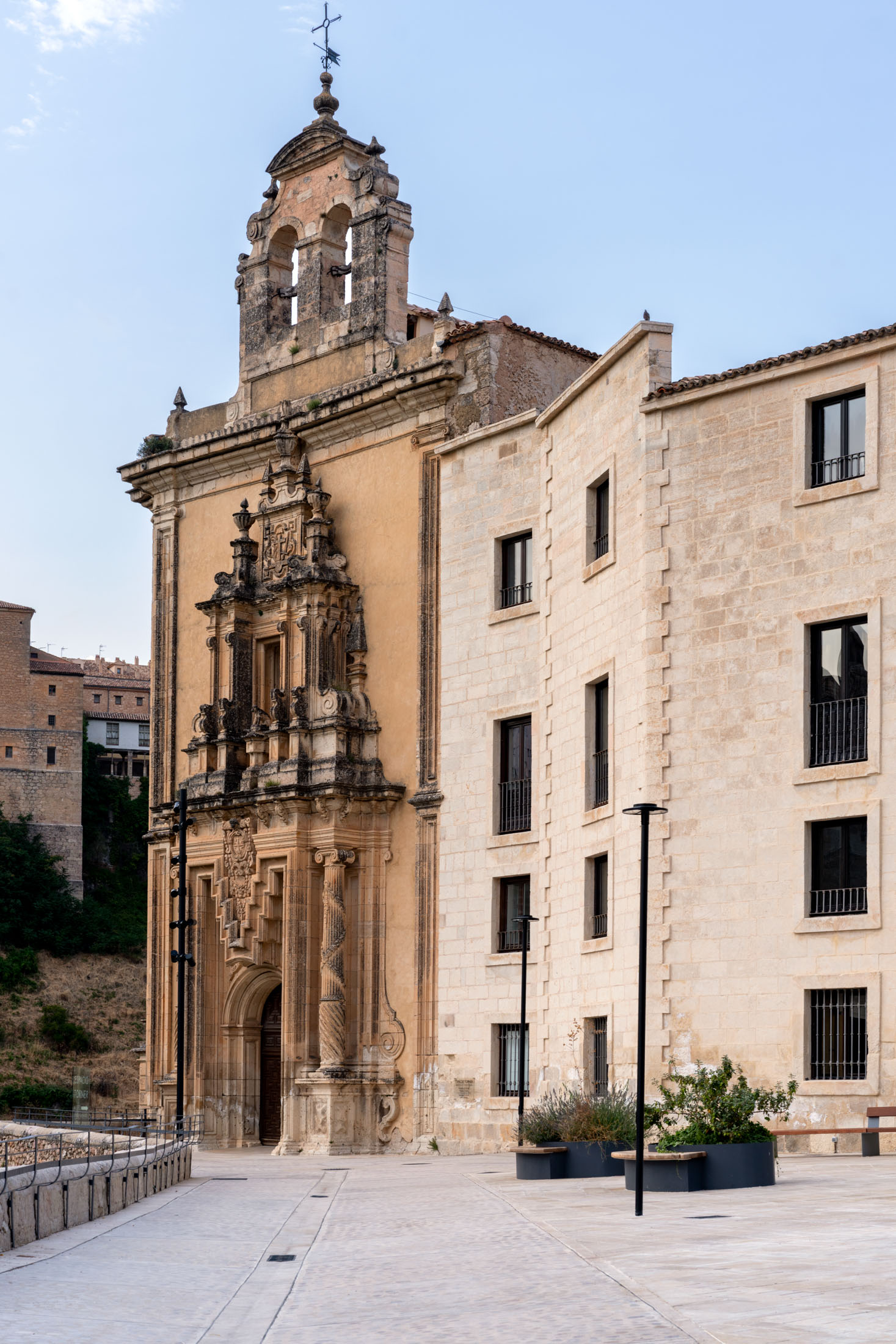
Why we like it: A Parador in the former 16th-century convent of San Pablo, in the Huécar gorge opposite the Hanging Houses, with a cloister, seasonal pool and parking.

Why we like it: A palatial house from 1621 on the Ronda de Julián Romero, hanging above the Huécar gorge, with balcony rooms over the ravine and a restaurant.
Services for this trip
Areas, for any way of travelling
| Area | Who it's for | Average night |
|---|---|---|
| Old town | Everything on foot, with views of the gorges | |
| Huécar gorge and San Pablo | The Parador, opposite the Casas Colgadas | |
| Serranía road | Campsite and cabins, for the Ciudad Encantada |
Where to eat
From set lunch menus to Michelin stars. We mark the price level and what to order at each place.
What to order: Morteruelo or zarajos to try the Cuenca classics, and a grilled meat or the vegetable platter

What to order: The traditional ajoarriero (€16) to start and the cured trout with ham meunière (€25) or the hind with mushrooms (€28); or the Acervo menu, €65

What to order: The Volver menu, of 10 courses, is the way in; the Cocinamos Cuenca, of 15, is the full experience.
Nearby
The closest places, whichever country they are in.

40.41° N · 1.44° W
By car

40.34° N · 1.11° W
By carCar-free

40.00° N · 1.04° W

40.14° N · 3.42° W
By carCar-free
Tips
It is the closest car park to the old town and leaves you going downhill for the rest of the day.
Many close on Monday; on Sunday, in the afternoon. The tourist office publishes the hours each month.
There is no online sale or reservation: arrive with a margin before closing.
The Casas Colgadas lit up are the best image of Cuenca.
Cuenca was built on a rock spur between two rivers, the Júcar and the Huécar, which have each cut a deep gorge on either side. The houses reach the edge and some, the Casas Colgadas (Hanging Houses), lean out over the void with their wooden balconies. Up top are the cathedral, the Plaza Mayor and an old town that can be explored on foot in a day; half an hour by car, the Serranía, with the Ciudad Encantada. It is almost the same distance from Madrid as from Valencia, and the AVE links it to both.
By car, from Madrid it is about 165 km along the A-3 and A-40, around an hour and fifty minutes. From Valencia, about 200 km along the A-3 and A-40, around two hours. From Albacete, a little over an hour and a half; from Guadalajara, about two hours on national roads.
By train, Cuenca is on the Madrid – Valencia high-speed line. The station, Cuenca-Fernando Zóbel, is on the outskirts: city bus line 10 takes you to the bus station, and lines 1 and 2 go up to the castle, at the top of the old town. The Serranía and the Ciudad Encantada have no public transport.
Don't put the Plaza Mayor into your satnav: the old town has narrow, one-way streets and almost no room. The practical thing is to leave the car down below, in the new part, and go up by bus or on foot, or drive up to the castle car park, at the very top, and walk down to the cathedral.
One day for the old town: the cathedral, the Casas Colgadas with the Museum of Abstract Art inside, the San Pablo bridge and a walk along the Huécar gorge. A second day for the Ciudad Encantada, which needs an hour and a half of walking plus the journey. With two nights there is time to eat without rushing and to see the old town lit up from the bridge.
In the morning, the cathedral on opening, at 10:00, and the Fundación Antonio Pérez, free on Sundays. Mid-morning, the Casas Colgadas and the Museum of Abstract Art, free, which closes at 14:30 on Sundays. You cross the San Pablo bridge to see the houses head-on and go down through the gorge. At lunchtime you have two options with a reservation: Raff San Pedro, with Cuenca cooking, or the tasting menu at Casas Colgadas. In the afternoon, if you are going by car, the Ciudad Encantada: in November the ticket office closes at 16:30, so don't cut it fine.
Cuenca cooking is shepherds' and river food. Ajoarriero, a paste of salt cod, garlic and potato, is eaten as a starter. Morteruelo is a hot pâté of game and spices. There is trout, lamb and game, and for dessert, alajú, a honey and almond sweet. To drink, wines of the province.
In spring, with the gorges green, and in autumn, with the Júcar's poplar groves yellow. Cuenca is high, at almost a thousand metres, and in summer it is easier to bear than the plain, although it heats up at midday. In winter it often freezes and the Ciudad Encantada can have snow or ice: bring boots. Holy Week, with its religious music, fills the city.
Questions
By car, around an hour and fifty minutes along the A-3 and A-40. There is also an AVE.
Yes, by AVE. The station is on the outskirts and you connect to the old town by city bus.
€5 for adults, €4 for ages 8 to 12 and free for under-7s. It is only bought at the box office.
Yes: inside is the Museum of Spanish Abstract Art, with free entry. It is closed on Mondays.
Up top, in the castle car park, or down below, in the new part, going up by city bus.
On the streets and the gorge, on a lead. In the Ciudad Encantada too, always on a lead. The Hotel Leonor de Aquitania admits pets on request.
Geocaliahttps://www.geocalia.com/en/spain/castilla-la-mancha/cuenca


