

Guided visit to the old University of Alcalá
1 hEveryone; the visit is guided at fixed timesAll year; Sundays at 11:00, 12:00 and 13:00
Visit · 1 h · €6 · The College of San Ildefonso, the Paraninfo and the chapel with Cisneros's tomb
40.48° N · 3.36° W
Cisneros's university, Cervantes's birthplace, the arcaded Calle Mayor and the Roman city of Complutum, 35 minutes from Madrid on the Cercanías.
Part of Scenic train journeys in Spain
What to do
Each plan says how long it takes, who it's for and whether you can book.
Visit · 1 h · €6 · The College of San Ildefonso, the Paraninfo and the chapel with Cisneros's tomb

Museum · 45 min · Free · The house on Calle Mayor where Cervantes was born in 1547, also open on Sunday afternoon

Walk · 1 h 30 · Free · The arcaded street, the Corral de Comedias and the tower you can climb free every morning
Itineraries
Days and weekends already planned out, with how to get between each stop and who to book with.
Plan the trip
Each choice narrows the next: the season shapes how best to travel, and how you travel decides where you stay and where you eat.
When to go
All year. In spring and autumn, the Tren de Cervantes and walks in the sun; in summer, set out early and leave the afternoon for the museums. In winter, few people.
How you travel
Choose how you're travelling and we'll tell you where to stay, how to get around, where to eat and which services you'll need. We only show the ways of travelling that make sense here.
Alcalá is about 30 km from Madrid by the A-2 or the R-2. The car is for getting there and for going to Complutum, on the outskirts; inside the old town you go on foot. Park in a public car park on the edge of the centre.
It is one of the easiest destinations without a car: the Cercanías C-2 and C-7 leave Atocha and Chamartín very frequently and the old town can be covered entirely on foot from the station. On spring and autumn Saturdays, the Cervantes Train makes the journey with actors and a guided visit.
Who you're with
A trip with a toddler is not the same as one with a teenager. Pick yours to see what works and what to bear in mind.
Alcalá works well with children because it is flat, pedestrian and almost everything is free: Cervantes's house, the archaeological museum and the Roman site. Distances are short and on every square there are storks on the bell towers.
Where to stay
We show you what suits the way you travel.Change how you travel
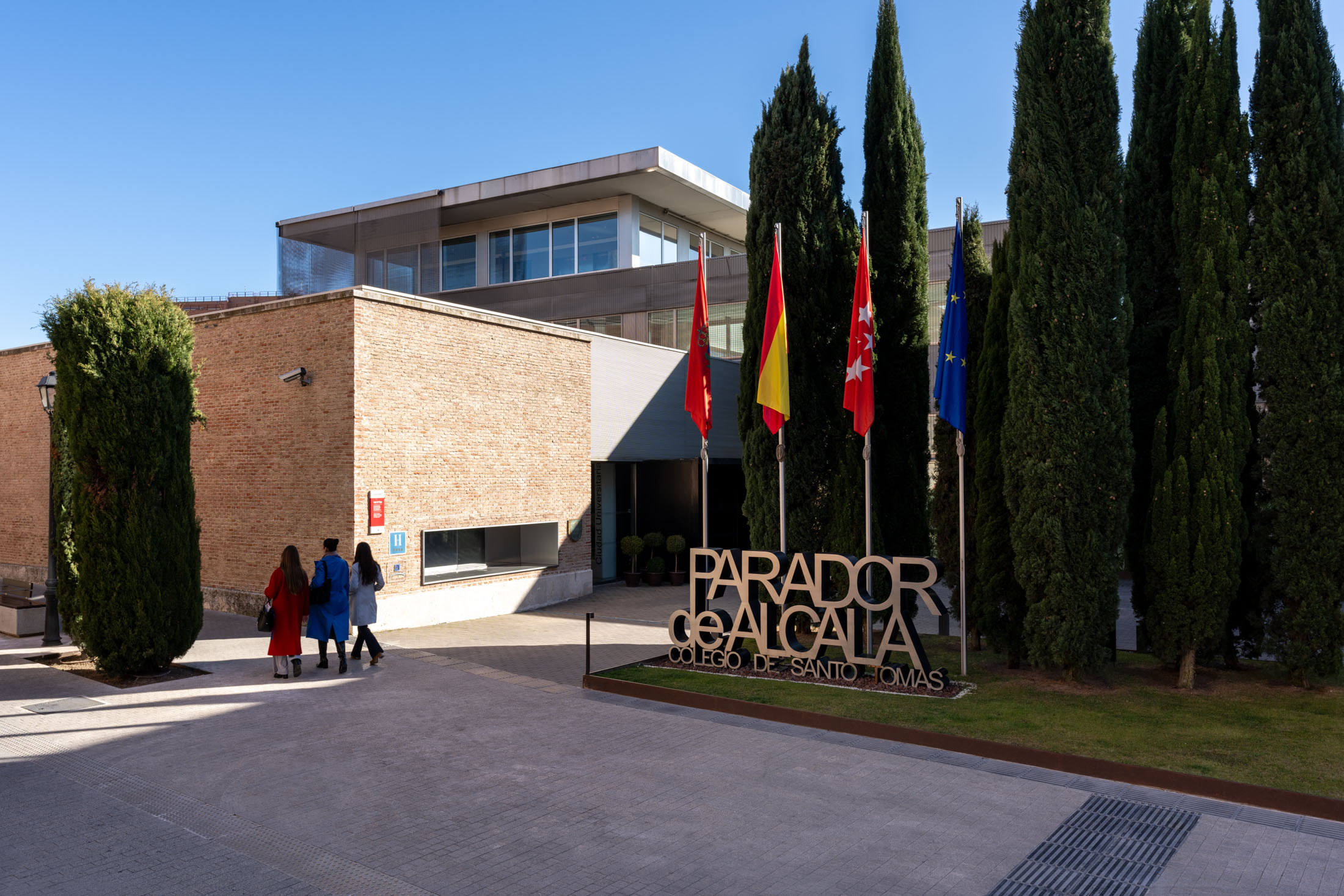 © ParadoresHotel
Why we like it: Four-star parador in three 17th-century Cisneros colleges, with spa, seasonal pool and garage, two minutes from the university.

Why we like it: Three stars on Plaza de San Diego, with rooms facing the university façade, 24-hour reception and private parking nearby.

Why we like it: Small hotel in a charming building on Calle Imagen, next to Cervantes's birthplace, with doubles from €89 and its own restaurant.
Services for this trip
Areas, for any way of travelling
| Area | Who it's for | Average night |
|---|---|---|
| Historic centre | University, Calle Mayor, Cervantes and cathedral | |
| Complutum | Roman site beside El Juncal |
Where to eat
From set lunch menus to Michelin stars. We mark the price level and what to order at each place.

What to order: Alcalá sopa boba or duelos y quebrantos, and cocido croquettes to share

What to order: On weekdays, the €26 daily menu with a drink; Friday and Saturday nights, the Noches de Mesa 12 tasting menu (€37.50)

What to order: Raciones to share: Iberian ham croquettes (€10), broken eggs with small prawns (€14) and grilled sirloin (€29); for dessert, Alcalá costrada (€5.50)
Map
The places to stay and services on the map are the ones for the way you travel. Turn on the layers you want and tap a point to see its details.
Nearby
The closest places, whichever country they are in.

40.42° N · 3.70° W
Car-freeBy plane

40.14° N · 3.42° W
By carCar-free

40.74° N · 3.88° W

40.03° N · 3.60° W
By carCar-free
Tips
The Sunday sessions have limited capacity: book on the university's visits website or with CompluTour, which combines it with a walk through the old town.
The C-7 runs every 10 minutes and drops you fifteen minutes from the Plaza de Cervantes: no parking and no toll.
La Hostería del Estudiante closes its kitchen at 15:30 and does not serve dinner on Sundays.
University at 11:00, Cervantes's house and the archaeological museum before 15:00.
Alcalá de Henares is the university city that Cardinal Cisneros founded in 1499 and the place where Miguel de Cervantes was born in 1547. Its university and historic precinct have been a World Heritage Site since 1998: it is the only city in the Community of Madrid with that title. It is covered on foot in a day: the Plateresque façade of San Ildefonso, the arcaded Calle Mayor, Cervantes's house, the Magistral cathedral and, on the outskirts, the Roman city of Complutum. Almost everything is free and almost everything is ten minutes' walk from the Plaza de Cervantes.
It is one of the few destinations of this kind that is better done without a car. The Cercanías C-2 leaves Chamartín and Atocha every 20 minutes and the C-7 every 10, according to the tourist office; the journey takes about 35 minutes and from the station to the centre it is a quarter of an hour's walk. ALSA buses 223, 227 and 229 from Avenida de América also arrive. By car it is about 30 km along the A-2 (exit 23, historic centre) or along the R-2 toll motorway, between 30 and 40 minutes depending on traffic. From Guadalajara, the C-2 arrives in half an hour and along the A-2 it is a little less; from Barajas airport, 14 km away, there is the 824 line.
On Saturdays in spring and autumn there is also the Tren de Cervantes: it leaves Atocha at 10:36 with actors on board and includes a guided visit of the city. It costs €22 for adults and is bought on the Renfe website.
In the old town you cannot park on the street. The tourist office lists several public car parks less than ten minutes' walk from the centre: the Recinto Ferial one, with 457 spaces, GAL (180), Paseo de los Pinos (110), Roca (200), Luis Vives (75) and El Silo (200). There are also park-and-ride sites at La Garena and at the station, and private ones at the Mercado, La Paloma and San Lucas. For Complutum, on the outskirts, there is room beside the El Juncal sports centre.
One day covers the essentials: the guided visit to the university, Cervantes's birthplace, Calle Mayor and lunch. If you want to add Complutum and the archaeological museum, which is what children like most, count on a long day or sleep a night. With a night you dine in the old town, see the Plaza de Cervantes lit up and leave Sunday morning for the Roman site.
Start in the Plaza de Cervantes, at the tourist office in the Capilla del Oidor, and climb the tower of Santa María, free in the morning. Two minutes away, in the Plaza de San Diego, the university can only be visited with a guide: on Sundays there are sessions at 11:00, 12:00 and 13:00, for €6. Then go down Calle Mayor, arcaded from end to end, to Cervantes's birthplace, at number 48, and the Antezana hospital, of 1483, which still operates. At the far end are the Magistral cathedral and, to the left, the regional archaeological museum and the monastery of San Bernardo. In the afternoon, Complutum: the forum, the House of the Griffins with its wall paintings and the House of Hippolytus with the fish mosaic.
On Mondays almost all the museums close: Cervantes's house, the archaeological museum, Complutum and the Antiquarium. On Sundays, the Magistral cathedral is not open to the public; San Bernardo is, from 11:00 to 15:30. The archaeological museum closes on Sunday at 15:00 and the university runs its last sessions at 13:00, so Sunday is a morning day. Cervantes's house holds out until 19:00.
Alcalá can be visited all year. Spring and autumn are best for strolling, and are the seasons of the Tren de Cervantes. In summer it is plateau heat: do Calle Mayor in the morning, in the shade of the arcades, and leave the middle hours for the museums. Watch out for Complutum in July and August: it opens only in the morning. In winter there are few people and the square is in the sun.
Questions
The university with a guided visit, Calle Mayor, Cervantes's birthplace, the Magistral cathedral and, if you have time, the Roman city of Complutum.
On the Cercanías, lines C-2 and C-7 from Atocha and Chamartín, in about 35 minutes, or on buses 223, 227 and 229 from Avenida de América.
€6 with a guide (€4 reduced). With CompluTour, €16 with a walk through the old town included.
Yes, and it is open from Tuesday to Sunday; it is closed on Monday.
A special train with actors that leaves Atocha on Saturdays in spring and autumn and includes a guided visit. It costs €22 for adults and €16 for ages 7 to 11.
No. The Magistral cathedral is open Monday to Saturday; on Sunday you can see the monastery of San Bernardo.
Geocaliahttps://www.geocalia.com/en/spain/community-of-madrid/alcala-de-henares


