What to do · Hondarribia
The walled old town
Information
- Price
- Free
- Duration
- 1 h 30
- Season
- All year
- Who it's for
- Everyone; slopes and cobbles
- With a dog
- On a lead, in the streets
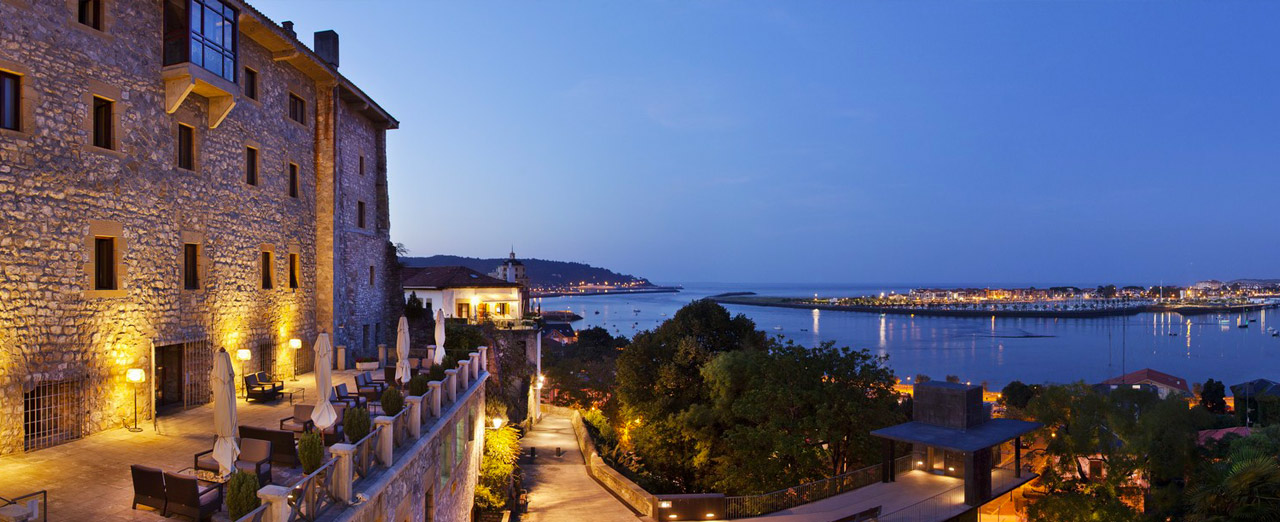
Hondarribia's old town keeps its walled enclosure above the bay. Enter through the Santa María gate, climb Calle Mayor (Kale Nagusia), with its stone houses, coats of arms and wooden eaves, and you will reach Plaza de Armas, dominated by the Charles V castle: a military fortress above the Bidasoa, with thick walls, that is now a Parador. Come down by the church of Santa María de la Asunción and walk round the walls.
It is an unhurried walk of an hour and a half, with slopes and stone paving: with a pushchair it can be done, but it is hard work. The tourist office is in Plaza de Armas itself, at number 9.
The walls and their gates
Hondarribia was a frontier stronghold and paid for it with nine sieges. Hondarribia Turismo recounts the main ones: in 1476 the French withdrew after nine days; in 1521 French and Navarrese forces took the town and held it for more than two years; in 1638 a French army of 18,000 men besieged it for 69 days without being able to get in; and in 1794, after seven days, it fell to Revolutionary France, and the fortress stopped functioning.
The walls, built of Jaizkibel limestone, were reinforced at the end of the 15th century and in the 16th with towers, bastions and moats. The Santa María gate keeps its arch and a town coat of arms dated 1694; the San Nicolás gate has a Gothic doorway of the medieval wall inside. To see the best-preserved stretches, walk the perimeter from Santa María towards the Gernika tree gardens. Along the way are the Leiva bastion, from the 16th century, with its countermine gallery; the Reina bastion; and the San Felipe bastion, from the 17th, where a casino was installed in the 19th century.
Calle Mayor and Plaza de Armas
Calle Mayor is cobbled all the way. At number 20 is the Town Hall, Baroque, from 1735; at number 5, the Casadevante house, where the truce of the 1638 siege was negotiated; at number 8, the Zuloaga house, with the municipal archive and library; and at number 2, the Ladrón de Guevara house, with its glazed blue brick façade. On Calle Juan de Laborda, the Eguiluz palace put up Joanna the Mad and Philip the Handsome for three days in 1502.
At the top, the castle is attributed to Sancho Abarca of Navarre and was extended by Sancho the Wise in 1190; its sober façade dates from the time of Charles V. It was castle and palace at once, and since 1968 it has been a Parador. Plaza de Armas was used for drilling the troops and also for festivals, bullfights and proclamations.
The church
The church of Santa María de la Asunción y del Manzano is Gothic with Renaissance additions. Work began around 1474 and the first phase was completed in 1549, when the Bishop of Bayonne consecrated it. The Baroque tower dates from the 18th century. Inside are Baroque altarpieces from the early 18th century, a neo-Gothic high altarpiece from 1914 and a Neapolitan Baroque Virgin that arrived in 1753.
Accessibility and tips
Bidasoa Turismo warns that the old town has steep slopes, steps and very narrow pavements, and that the parish church is not wheelchair accessible because of the steps at the entrance. Don't drive up: park below, in the Marina. The Arma Plaza office (943 643 677) provides leaflets on the walled town, and there is an official app with a guide in Spanish, Basque, French and English. If you are staying inside the walls, the Palacio Obispo is beside the church. Afterwards, go down to the Marina for pintxos, or have lunch at Alameda.
As a familyWith a dog